If you find yourself yearning for a smaller home to call yours, you’re not alone.
According to a 2017 survey from real estate site Trulia, 60% of people living in homes of 2,000 square feet or more said they’d like to downsize to a smaller house with less living space.
Michelle Hale, organizer and co-founder of Henry & Higby, says people downsize for a number of reasons: to achieve financial goals, reduce home maintenance costs, improve their quality of life, stock away more spending money, or make a change after their kids have moved out and the housing situation no longer fits their needs.
Nonnahs Driskill, founding organizer of Get Organized Already! in Pasadena, CA, adds that people often downsize if they’re tired of the constant home maintenance upkeep their house requires, if their health declines and they can no longer navigate a large house, or because they want to move to a more expensive area and can’t afford a large home.
Whether you’re moving for any reason or are currently in a larger home, transitioning to a smaller home can be an excellent way to enhance your quality of life while achieving your financial goals. Downsizing can also be an emotional experience that requires careful planning.
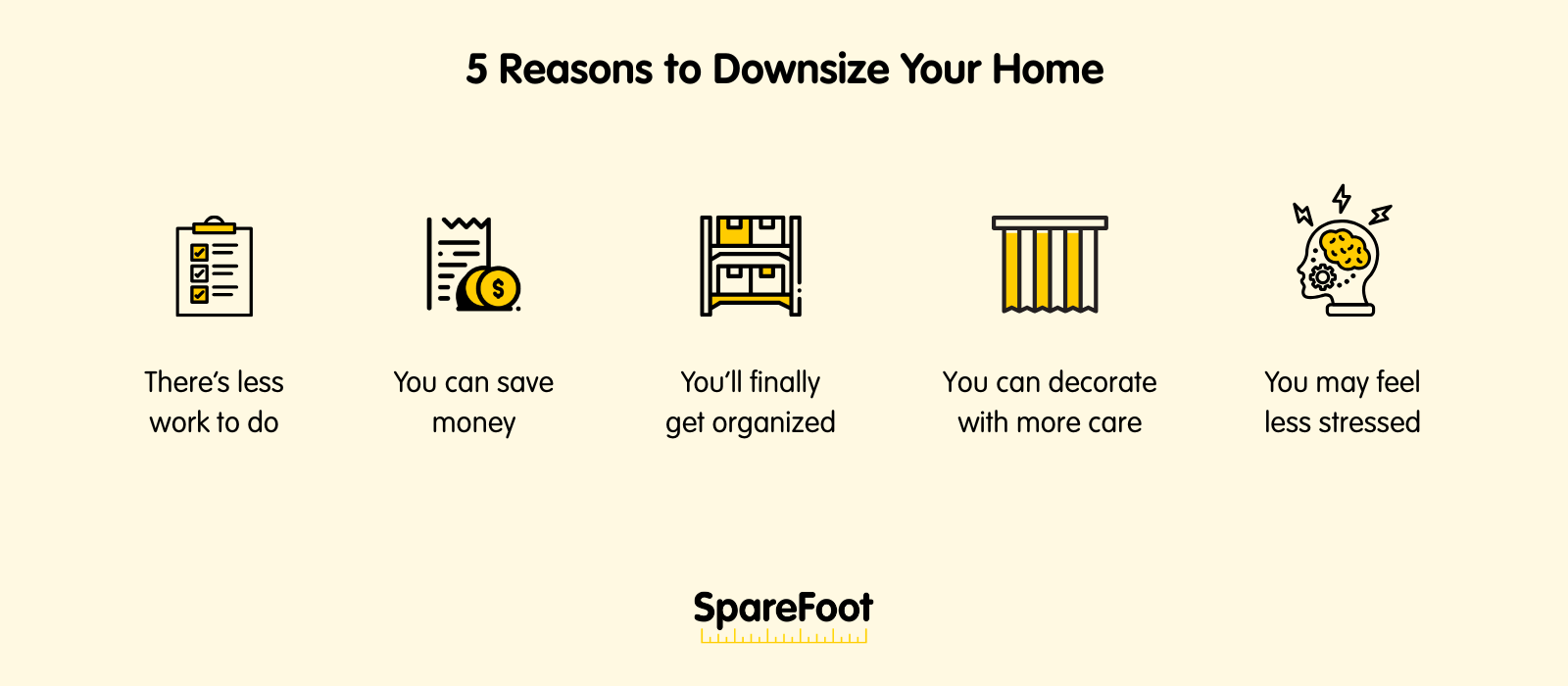
1. There’s Less Work to Do.
The bigger your property, the more living space and stuff you have to care for. That includes furniture, kitchen appliances, personal items, outdoor supplies, and household supplies, plus multiple rooms, a home office, and a large backyard, patio, basement, or pool that require ongoing home maintenance.
“All of that sounds wonderful, but it adds up to a lot of work keeping things cleaned [and] storage organized,” says Driskill.
A smaller house, on the other hand, requires significantly less home maintenance effort and time, Hale says, which means you’ll have more freedom and energy to focus on the activities you love and pursue your financial goals.
2. You Can Save Money.
If you’re moving from the suburbs to a downtown city apartment or condo complex, or relocating closer to the beach where property values are higher, downsizing may not be the most cost-effective option. Consult a real estate agent for a Comparative Market Analysis of your current housing situation. In general, though, moving to a smaller house can help you reduce your fixed expenses, account for moving expenses and moving insurance, and still save money for travel or retirement to meet your financial goals, Hale says.
That’s because you’ll likely have a smaller mortgage payment with better mortgage rates, more affordable property insurance and property taxes, cheaper utility bills, and fewer home maintenance and upkeep costs. Factor in closing costs and moving expenses when calculating savings. And here’s the kicker: if you have a good amount of home equity tied up in your home, you might even be able to make money selling it. Work with a real estate agent to get a Comparative Market Analysis that factors in current property values and mortgage rates.
3. You’ll Finally Get Organized.
“Living in a smaller house with less living space forces you to declutter and streamline your life, potentially embracing a minimalist lifestyle,” Hale says.
If you’re moving from a five-bedroom house to a two-bedroom condo complex, not only will you have to get rid of worn-out sofas, particle board furniture, decor, and appliances, but you’ll also have to pare down your personal belongings since you won’t have as much storage space or room for a dedicated home office.
And while the idea of purging the majority of your stuff might seem daunting, it’s a transformative and worthwhile pursuit—even an emotional experience. Consider using decluttering strategies to make the process smoother. Not only does it force you to strip away the non-essential items from your life and embrace a minimalist lifestyle, but it also teaches you to be more organized, resourceful, and intentional with the things you bring into your living space. Use a storage unit temporarily if needed during the transition.
4. You Can Decorate With More Care.
In a smaller house, every design decision—however seemingly small—has a direct impact on the ambiance and utility of your living space, whether it’s your main living area or your home office. And while that may seem like a lot of pressure at first, it’s actually a huge bonus. With fewer rooms to furnish and less square footage to fill, you can be more thoughtful and intentional about your space.
Instead of feeling obligated to deck out every empty corner or buy things you don’t love just to complete a room, you can devote more time and energy to decorating exactly the way you like, whether that means repainting the kitchen blue or carefully designing a gallery wall in the living area.
5. You May Feel Less Stressed.
Fewer expenses, less home maintenance work, and a more organized, smaller house inevitably create less stress for you and your family while helping you reach your financial goals. That’s not to say that the actual downsizing process—searching for homes, making a decision, purging, packing, and transporting everything—isn’t stressful in and of itself.
Like any move, downsizing is a major emotional experience and undertaking that benefits from hiring professional moving services and securing moving insurance, but settling down in a new, smaller house can save you a lot of headaches down the road.
Tips For Downsizing
- Use Your New Floor Plan as a Guide. Hale says it’s crucial to examine your new, smaller house floor plan before the move, including closet space, storage spaces, and whether you’ll have room for a home office, so you can take an inventory of the items you’ll be bringing and plan accordingly. “This will help make the unpacking process quicker and easier,” she adds.
- Purge Before You Pack. If possible, start the decluttering process using effective decluttering strategies several weeks before you move. Hire a moving company early to get quotes on moving expenses and moving insurance. “Handling this first will save time, money, and stress in the long run, as you won’t be paying moving expenses to transport items that you no longer want or need. Consider renting a storage unit temporarily for items you’re unsure about,” Hale explains. Go through each area of your home and sort through your stuff—including big items like furniture, worn-out sofas, particle board furniture, artwork, appliances, and outdoor supplies. Use storage containers to organize items for donation or sale. Be ruthless and get rid of whatever you don’t love, use regularly, or have room for in your new, smaller house. Sell marketable items at a yard sale or through an estate sale company, and donate the rest. “Most people who go through a major downsize are very surprised about how much they do not miss the belongings they relinquished,” says Driskill.
- Have a Plan For Sentimental Items. Even the most experienced declutterers can find it difficult to let go of certain items, which is why it’s important to have a plan in place. “If during the process you find items you are very hesitant to let go of for sentimental reasons,” Driskill says, “store those things temporarily in a good, sturdy box or storage containers, or rent a storage unit short-term.” She advises labeling the box with the date you packed it, then storing it out of sight. After a few months, Driskill explains, you’ll be able to make a much easier, quicker decision about what to do with your stuff.
- Understand Your Motivation For Downsizing. Are you downsizing for retirement to tap into your home equity? Or are you downsizing because you’re tired of home maintenance on a large house and want a smaller house that fits your housing situation and financial goals better? Whatever your reason, it is important to identify and understand your motivation for moving so that you can come up with a plan that fits your needs.
- Hire a Real Estate Agent. Make sure you hire a real estate agent to conduct a Comparative Market Analysis and advise on current property values and mortgage rates. Schedule a home inspection to identify needed repairs before listing. Research moving companies to compare moving expenses and moving insurance options, or consider professional moving services for a stress-free experience. These professionals help you navigate closing costs, maximize your home equity, and ensure a smooth transition to your new, smaller house.

Paige Smith
Paige Smith is a freelance writer from Orange County, California. She specializes in lifestyle, wellness, and travel topics.