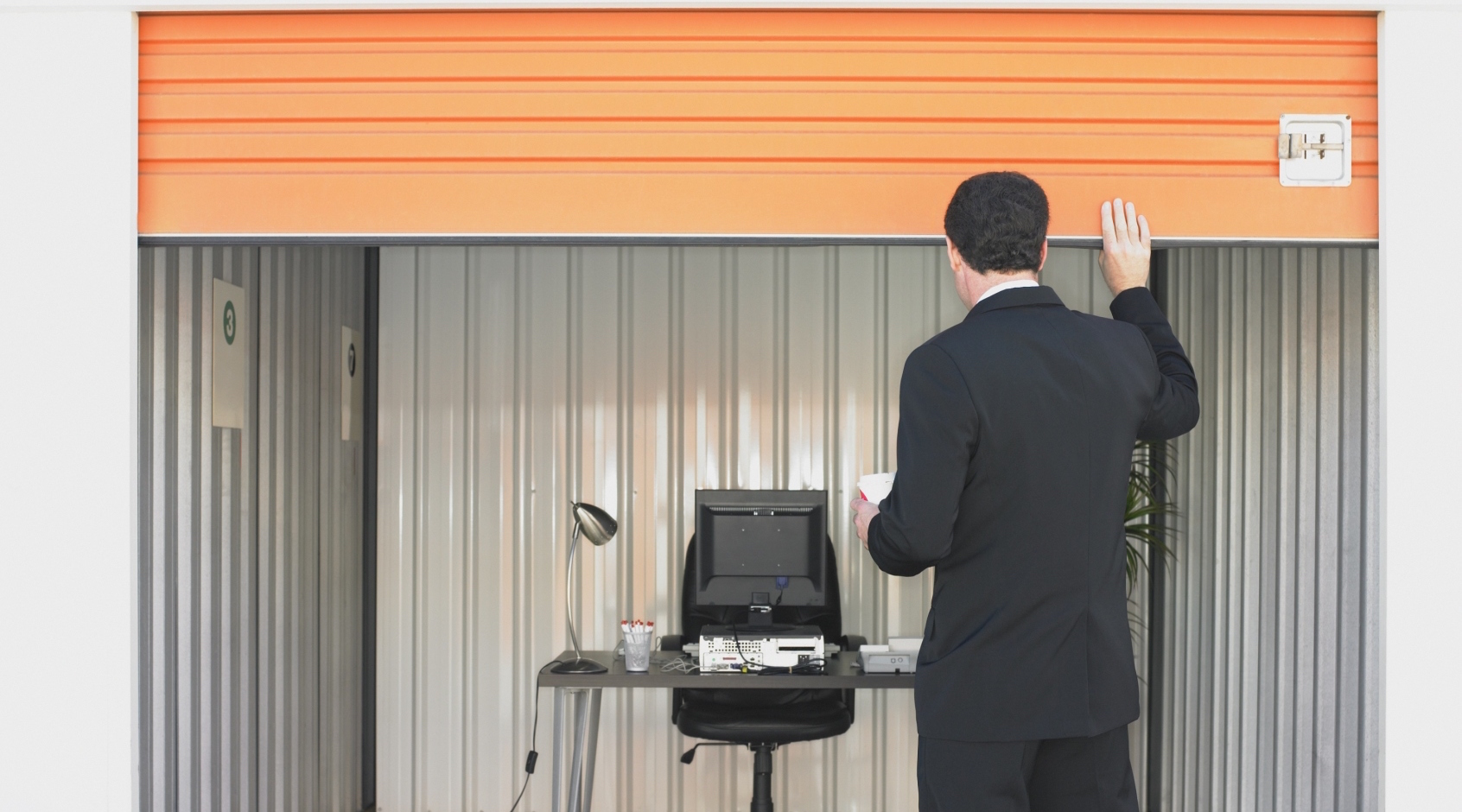
Tenants nationwide at self-storage facilities use their storage units for the intended purpose: to store their excess belongings.
But the rule breakers that ignore their lease agreements and operate businesses from their units provide the best stories in the industry.
About 1 out of 5 storage customers, including small businesses, use their storage unit for work or as a practice space, according to a nationwide survey recently conducted by SpareFoot.
Many risk being evicted, and perhaps arrest and prosecution, especially the most egregious violators of local zoning codes.
Running a Business Inside a Storage Unit: Cautionary Tales
The Latrine Digging Artist Colony
One self-storage facility on Florida‘s east coast had weak management and a high occupancy rate of rule-breakers. Tenants transformed the storage facility into somewhat of an artists’ colony.
“The manager wasn’t there, and the owner wasn’t attentive. There was arc welding and glass blowing. There were all sorts of activities that would require better ventilation and climate control,” said Jeffrey Greenberger, a partner in the Cincinnati law firm of Katz Greenberger and Norton LLP. He specializes in self-storage law.
“The management office bathroom broke, and the owner never fixed it. These folks got together and built eight of their own septic facilities into the facility, under the units,” Greenberger said.
Oh, yuck.
“If you don’t watch, you could end up with unlicensed septic systems, dug by the tenants, in plain daylight, for their own needs,” Greenberger said. “It’s not really zoned or designed for people to spend a lot of time there.”
Artists and collectors – fear not! Despite the cautionary tale above, there is a right way to store artwork in a storage unit.
More Tales From Behind the Rollup Door
Greenberger has a lot more where that came from in his files:
A man who lacked a medical license operated an OB/GYN clinic from a Dallas storage unit.
“Low prices, no questions about insurance were asked,” Greenberger said, explaining how he got away with it.
Then there are the fire starters.
“The most common fires are people who use self-storage facilities as makeshift commercial storage units for working on cars.” Greenberger said, “They’re a good mechanic but can’t afford warehouse storage or a day job at an auto repair company. They work on exhaust systems in these unventilated, not-fire-rated spots.”
One renter doing arc welding set a unit on fire. “An irreplaceable collection of antique surfboards was destroyed about four units away,” he said.
Safety Not First
Fires can spread quickly to adjacent units despite security features and basic firewalls. Regular commercial buildings include more firewalls.
“There are firewalls in self-storage facilities, but not between every unit,” Greenberger said. “Perhaps every 20 units, whatever the code requires. A fire in another unit would take you out rather quickly.”
The bottom line, Greenberger said, is that self-storage units, whether standard or climate-controlled storage units, are not suitable for most business activities.
“For the most part, these units aren’t ventilated, not designed for people to be in for long periods of time. There’s often no electricity in the unit. If you’re injured or get stuck in the unit, there’s a very good chance that no one will know,” Greenberger said.
Breaking the Law
Storage companies and their facilities must adhere to municipal codes, which disallow conducting business operations or operating a business.
“You may get away with it for a while, but the first time there’s a police call to break up a fight between two workers fighting at the offices of ABC Co. … the police will report it to the code department,” he said.
To be clear: Greenberger isn’t referring to renters who store products or inventory–– particularly for the holiday shopping season or seasonal business needs.
“Lots of plumbers use business storage for the inventory storage of their copper and toilets. Lots of decorators receive custom-made furniture. That’s a fine business use for a self-storage facility,” Greenberger said.
Greenberger said a line is crossed when someone is working in a unit for a prolonged period of time.
“If you set up an office in the back, and know a person will be sitting there multiple hours per day, you’re waiting for a fatality,” Greenberger said.
No Business Allowed
Many storage operators discourage business users from protecting their profit margin and avoiding liability.
Carlos Diaz, vice president and general manager of Value Store IT Management Inc. of Miami Lakes, FL, is clear that no businesses are allowed. His company focuses on maximizing net operating income across 8,500 units.
“It’s a self-storage unit, not meant to be used as an operating business,” he said. “It’s written in the majority of leases in the state of Florida, and I believe in every other state.”
His company has 8,500 units spread among 13 facilities in four states.
Appropriate Business Uses
Other storage unit facility operators welcome business customers, as long as they follow the rules.
Denver, CO-based Greenbox, a modern storage facility, supplies conference rooms, desks, WiFi, and even a coffee maker at its facility near Coors Field.
“A lot of tenants have an online business, something they make, or they’re selling T-shirts that they screen print,” said Josh Fine, vice president and legal counsel for Focus Property Group, which operates Greenbox.
“They need a place to fulfill orders; we’ll help with that. We’ll accept shipments for them, give them space to do their fulfillment,” Fine said.
Here are two concluding sections that provide helpful, factual guidance:
How to Legally Use a Storage Unit for Your Business
If you need storage space for your business, there are legitimate ways to use a storage unit without violating your lease or local codes. The key is understanding the difference between storage and operation.
Permitted business uses typically include:
- Storing inventory, supplies, and equipment when not in use
- Housing seasonal merchandise during off-peak times
- Keeping business records and archived documents
- Storing tools and materials between job sites
- Warehousing products for an online business
The critical distinction is that you’re storing items, not conducting business activities inside the unit. As Greenberger noted, plumbers storing copper pipes and toilets, or decorators keeping custom furniture, are examples of appropriate business storage.
Best Practices for Business Storage Users
Before renting a storage unit for business purposes, take these steps to stay compliant:
Read your lease agreement carefully. Look for specific clauses about business use, time limits on the site, and prohibited activities. Many facilities explicitly forbid using units as workspaces or offices.
Be transparent with facility management. Inform the storage facility that you’ll be storing business inventory or supplies. Ask about any restrictions or requirements for commercial storage. Some facilities offer specific business storage options with appropriate insurance and access terms.
Check local zoning laws. Verify that your intended use complies with municipal codes. Storage facilities are zoned for storage, not for conducting business operations or serving customers.
Consider facility features. If you need frequent access to inventory, look for facilities with extended access hours. For climate-sensitive products, rent a climate-controlled unit. Some modern facilities, like Greenbox, specifically cater to business customers with amenities designed for entrepreneurs.
Get proper insurance. Standard storage unit insurance may not cover business inventory. Discuss your needs with your insurance provider to ensure adequate coverage.
The bottom line: storage units can be valuable assets for businesses that need extra space—as long as you’re storing, not operating.

Bruce Goldberg
Bruce Goldberg is a freelance writer and editor based in Denver. He worked in newspapers and magazines as both a business writer/editor and sportswriter/editor for 35 years.