

KEY TAKEAWAYS
▸ Before packing anything, use a decision framework to confirm moving your parent in is the right call for everyone — not just a reaction to a crisis.
▸ Start the family conversation 3-6 months before move-in when possible, and handle legal and financial paperwork (POA, insurance, benefits addresses) early.
▸ Home safety modifications — grab bars, non-slip surfaces, lighting, and clear pathways — should happen before your parent moves in, not after.
▸ Downsizing works best sorted by category, not room, with a storage unit as the middle path between rushed decisions and clutter.
▸ The adjustment period continues well past move-in day — check in at 30, 60, and 90 days, and watch for caregiver burnout in yourself too.
There’s no doubt that sentimental flair is a part of an elderly parent moving in with their adult child.
But there’s so much more to it. There are logistical, household infrastructure, and financial shifts that have to happen. And beyond the sentimentality, there are emotional adjustments and capacities that moving your parents in with you will require.
There are lots of families who spend weeks listening to the tunes that pluck on their heartstrings. But there’s a tendency to neglect the floor plan, the paperwork, and where you’re going to put all their boxes.
And then there’s the opposite type of person, who gets lost in the logistics but fails to shine some light on their emotional landscape, which will certainly go through some large-scale changes.
Maybe you’re the type to wing it emotionally and move mom or dad in during a crisis without ever talking through expectations, resentments, or a backup plan.
Or maybe you’re keeping the logistics close to your chest, focusing on the feelings and mental health impact but avoiding the moving checklist, home modifications, and practical side of shoving in their 40-plus years’ worth of stuff with yours.
Either way, you’ve come to the right place.
Our guide on how to prepare for an elderly person moving in offers a framework for the decision process that includes the psychological side as well as the practical.
Once you decide if it’s the right move, we’ll move into how to handle the legal and financial paperwork. We’ll cover how to prepare your living space, how to downsize your parents’ home with compassion, and what the first 90 days actually look like.
We even offer an elderly parent moving-in checklist to streamline the process.
SpareFoot works with storage facilities around the country, compiling a variety of data on storage trends and moving logistics. When we’re done explaining how to navigate elderly parents moving in with you, we’ll reveal how SpareFoot can help you find a storage unit near you, and how to use it to help stagger your to-do list.
Is It Time? A Decision Framework for Elderly Parents Moving In With a Child
Before you start packing anything, it’s worth taking a moment to reflect on whether moving parents in with you is actually the right call, not just for you, but for them and for everyone else in your household.
The trigger for this decision can often be a crisis that’s sprung up unexpectedly. But while it’s not always within your control, this isn’t a decision to make in a reactive state.
Some signs it may be time to consider moving your parents in with you include:
- Safety Incidents: A fall, faulty or neglected maintenance, missed medications, or other safety incidents
- Social Concerns: Increasing isolation or a shrinking social network
- Mental Concerns: Noticeable cognitive decline or difficulty managing daily tasks
- Physical Shifts: A new chronic illness, injury, or diagnosis that changes their day-to-day needs
- Financial vulnerability: Unpaid bills, scam vulnerability, or an inability to manage household expenses
- Caregiver Regularity: A caregiver’s drive-time or cost burden that’s become unsustainable
Not all of these scenarios are black and white. Some of them come on fast, while others creep into existence day by day, month by month, until one day you find yourself wondering if your parent is safe.
But there’s another, uncomfortable reality you have to consider, being as objective as possible. Just because you feel it’s unsafe for your parent to live alone doesn’t mean that your house is the best place for them.
Here are some questions you can ask yourself to figure out if moving your elderly parent in with you is actually the right fit:
It’s worth saying plainly: moving in with their adult child isn’t always the right fit for your elderly parents, even if it’s their and your first choice. And that’s okay.
A senior living community, an assisted living facility, a nursing home for higher acuity needs, or home care services in their own home are all reasonable alternatives, depending on the level of care your parent needs.
If you’ve run through these lists of scenarios and questions and are still unsure, or find that you’re unable to be objective on this particular matter, that’s ok too. It’s your parent. A geriatric care manager, sometimes called an aging specialist or aging life care professional, can run a more formal care assessment and help you weigh these options with clarity.
And sometimes our parents’ needs are more complex than a standard decision framework alone can handle. In complex cases, the outside opinion is worth the cost.
If you’re just starting to research options, the U.S. Administration on Aging has a tool called the Eldercare Locator that can connect you with local resources, like adult daycare, to in-home care services in your parents’ neck of the woods.
Start the Family Conversation Long Before Moving Parents In With You
You want to have an honest conversation about moving parents in with you three to six months before the move-in date. Obviously, not all situations are the same, but if you can help it, giving everyone involved time to reflect and, if you decide to go through with it, prepare, eases the transition.
To be clear, we’re not saying this isn’t a one-time conversation—far from it. Nor will it be a one-on-one between you and your parent.
Preparing for your parents’ move-in requires a series of kind-but-honest conversations. After all, you may even be raising your own family by now. Involve your spouse, your kids if they’re old enough to be part of it, any siblings who share responsibility, and the parent.
And while this isn’t always an option, we suggest you do your best to involve your parent in the decision-making process as much as you can, so they don’t feel like you’re deciding for them.
It’s easy for us to feel the burden of having them enter our home and then to pat ourselves on the back for how selfless we are for moving our parents in. But remember, they’re the ones losing their home and independence at the same time.
And while there may be some realistic limitations they’re faced with, take strides to preserve as much of their autonomy as you can. It doesn’t have to be high-stakes decisions they’re making. You can reduce their resistance to the move by giving them small choices, like what furniture gets to come and how their new room is arranged.
Be honest with yourself about where friction is likely to show up. Get in front of sibling disagreements over who does and pays for what by discussing it all before the move. So are differing opinions about how much independence your parent should retain.
Explain your expectations about whether your parents and siblings plan to contribute to your household expenses.
Family dynamics that were manageable during special occasions and routine visits can ramp up in new ways once everyone’s under one roof. Call out any tension points now and establish boundaries before they cause serious interpersonal damage.
Handle the Legal and Financial Paperwork First
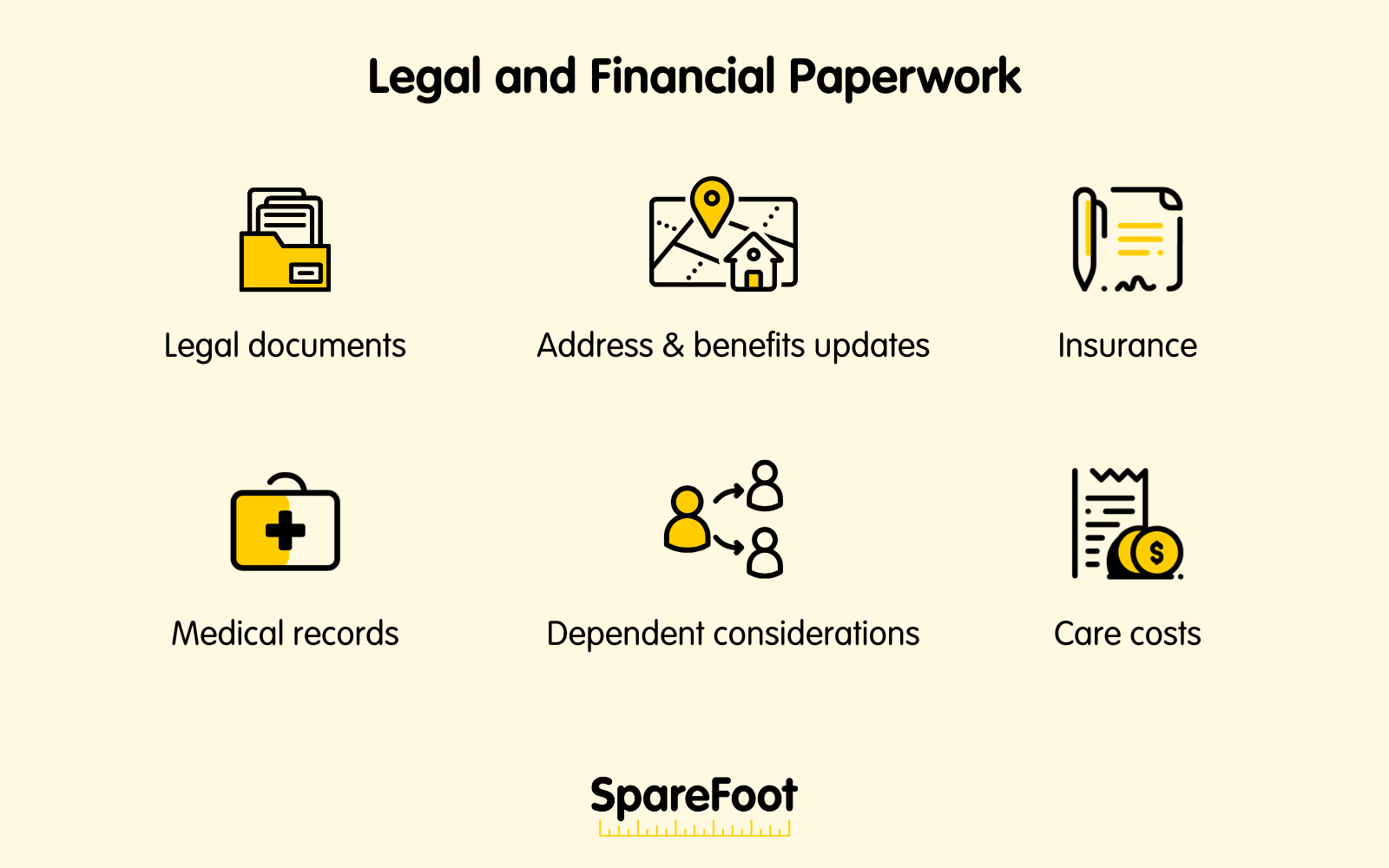
The first thing to do after deciding to move your parents in with you is to take care of the legal and financial paperwork.
Here are the pressing pieces of paperwork you’ll want to get squared away asap:
- Legal documents: Durable Powers of Attorney for both finances and healthcare let a trusted person act on your parent’s behalf if they become unable to. An advance directive or living will spells out their medical wishes. These are hard conversations to have under pressure, so handle them while your parent is still able to offer their wishes coherently.
- Address and benefits updates: Social Security, Medicare, pensions, insurance carriers, credit card companies, and banks all need the new address. If your parent is a federal employee or retiree, their agency may have its own process and timeline for this. So get started as early as you can.
- Insurance. Update your renters’ insurance or homeowners’ insurance policy by adding your parent as an official resident. If your parent is bringing a vehicle into the mix, run it by your auto policy. Confirm their health insurance coverage will transfer, especially if you’re moving them out of state. The Medicare rules can change by location.
- Dependent considerations: If you provide a certain amount of financial support, you might be able to claim your live-in elderly parent as a dependent. That comes with other new benefits like the Credit for Other Dependents. Depending on where you work, they may offer you a dependent care flexible spending account to help pay for daytime care so you can keep working. These caregiver credits and tax deductions have specific income and support thresholds, and rules change. Loop in a tax professional asap.
- Medical records: Consolidate your parents’ medical records and a list of current healthcare providers before the move. Depending on how close you live to their previous address, you may need to find a new primary doctor for them. You’ll want to go down the list of healthcare providers and decide who can continue to see you and who will need to be replaced. It’s best to let them be a part of this decision. And you’ll need to have all their medical records consolidated before their first appointment.
- Care costs, if you’ll need help: Hopefully, you took our advice in the previous sections and figured out how much supervision and hands-on care your parents need and who’s going to provide it. We suggest contacting and filling out the paperwork for any medical home health aides or simple home care aides before you’re stretched thin. Their long-term care insurance policy may cover in-home medical assistance. But again, that means paperwork.
Your Elderly Parent Moving Checklist
Relocating in any context almost always comes with a heavy load of physical and emotional tension. But moving as a senior or with an illness comes with its own set of hurdles.
Use our master elderly parent moving checklist by working backward from your target move-in date:
- Confirm the decision and timeline with the whole family
- Handle legal and financial paperwork
- Assess and modify your living space for safety and accessibility
- Downsize and pack up your parents’ home
- Decide what moves in, what goes to storage, and what’s sold or donated
- Set up their new room before their arrival
- Plan moving day logistics and pack a “first day” kit
- Establish routines and check in at 30, 60, and 90 days
Here’s a closer look at what each step involves:
1. Confirm the Decision and Timeline With the Whole Family
Hopefully, you’ve been discussing this for three to six months before you even start on this checklist. But that’s not always an option.
Whether it’s been a topic of conversation before or is coming up last minute, get your spouse, your kids, your housemates, siblings, and your parent together one last time to talk about the decision and plot out a moving date. Better to work through any disagreements about caregiving duties or finances ahead of time rather than mid-move.
2. Handle Legal and Financial Paperwork
With your dates set and your timeline in place, start the paperwork. Establish a Durable Power of Attorney and an advance directive, establishing which medical course to take if your elderly parent can’t communicate.
Update their insurance policies, Social Security, and Medicare with the address changes before move-in day. Then you can consult a tax professional about dependent status and any caregiver credits you might qualify for.
3. Assess and Modify Your Living Space for Safety and Accessibility
Walk through your home and imagine how your aging parent will get around and use the space. They’ll need bathroom access and the ability to control the lighting in their room.
Will they have to navigate stairs? Do they need clearance for a walker or wheelchair, or will they soon? Identify what needs grab bars, ramps, or other accessibility devices now. But install what you need, or have contractors make the changes as soon as possible, so the house is close to ready for your elderly parent to move in.
4. Downsize and Pack Up Your Parents’ Home
You’ll want to help your parents downsize and pack up their home long in advance, and do your best to let them participate in this process so they feel like they have agency in the situation and aren’t totally starting over.
Start with the least sentimental spaces like the kitchen, garage, towels, and linens. Work toward bedrooms, wardrobes, knick-knacks, and photo albums as the deadline gets closer.
While you’re packing up, sort by category and not by room to keep the process from stalling out on any one emotionally loaded space, for example, pots, pans, and utensils in one box, tools packed all together. Save things like photos or collectibles for a day when you have a lot of time.
5. Decide What Moves In, What Goes to Storage, and What’s Sold or Donated
There will probably be some stuff that simply won’t fit inside your house. We suggest letting your parents put as many of their own belongings in their new bedroom as possible. But that doesn’t necessarily mean that you need to get rid of everything else.
Some stuff will get sold or donated; other stuff can go into a storage unit close to the house, where your parents can be sure it stays safe and sound if they need it.
6. Set Up Their New Room Before Arrival
Again, this transition is a lot for everyone. And while losing and repurposing part of our space and learning to live with your aging parent is certainly a dramatic shift, your parent is losing their entire home.
You can ease both them and you and your current housemates into the new normal by having your elderly parents’ bedroom fully livable before your parent walks in the door.
Move your parents’ bed in there and have it made, stock their essentials, and display their familiar items like photos, artwork, or a favorite chair already in place.
7. Plan Moving Day Logistics and Pack a “First Day” Kit
If the move is local, schedule your moving day between two weeks and six weeks ahead of time, depending on whether it’s the slow season or the peak. A senior move manager can help you plan and personalize the process to your senior parent’s needs.
Whether or not you’re hiring professional movers, see if you can recruit a few able-bodied friends and family members who your elderly parents know to help, too. That way, it feels like an intimate family affair rather than a cold and calculated hustle.
Once you have the movers and friends and family support, adjust your timing with any medical appointments your parent might have that week.
Be sure to pack medications, ID, hygiene, a set of clothes and PJs, phone charger, a book or Kindle, and any other comfort items separately in a “First Day” kit. Keep the kit with your parent, so it doesn’t end up on the truck or in a storage unit by mistake.
8. Establish Routines and Check In at 30, 60, and 90 Days
Once the move-in is over, it’s tempting to feel like you’re over the hump. But the adjustment to living together is only the beginning. We suggest setting up a daily flow to follow. It doesn’t have to be too rigid. But a flexible scheduling of mealtimes, calls with other family, and social activities can help them feel settled in and cared for right away.
Check in with your aging parent and the rest of the family and housemates at the 30-, 60-, and 90-day marks to revisit how things are going and make any adjustments. This keeps things optimized and also lets everyone in the household feel like their voice is being heard and considered.
These check-in points are natural points to reassess anything left in storage, once the initial adjustment period has settled. You might not have space to move more into the house, but you can swap out some seasonal items and establish a rotation for things like books, artwork, photos, clothes, vinyl records, etc.
How to Prepare for an Elderly Parent Moving In:
You can prepare for your elderly parents’ move-in by making home safety modifications, downsizing your parents’ home with mindfulness, setting up their new living space before they move in, and building a “First Day” kit for moving day.
We covered a lot of these on our elderly moving-in checklist. But let’s review them with a focus on practical preparation, starting with some specific home safety and home modifications you can make to help out.
Home Safety and Home Modifications for an Elderly Parent Moving in
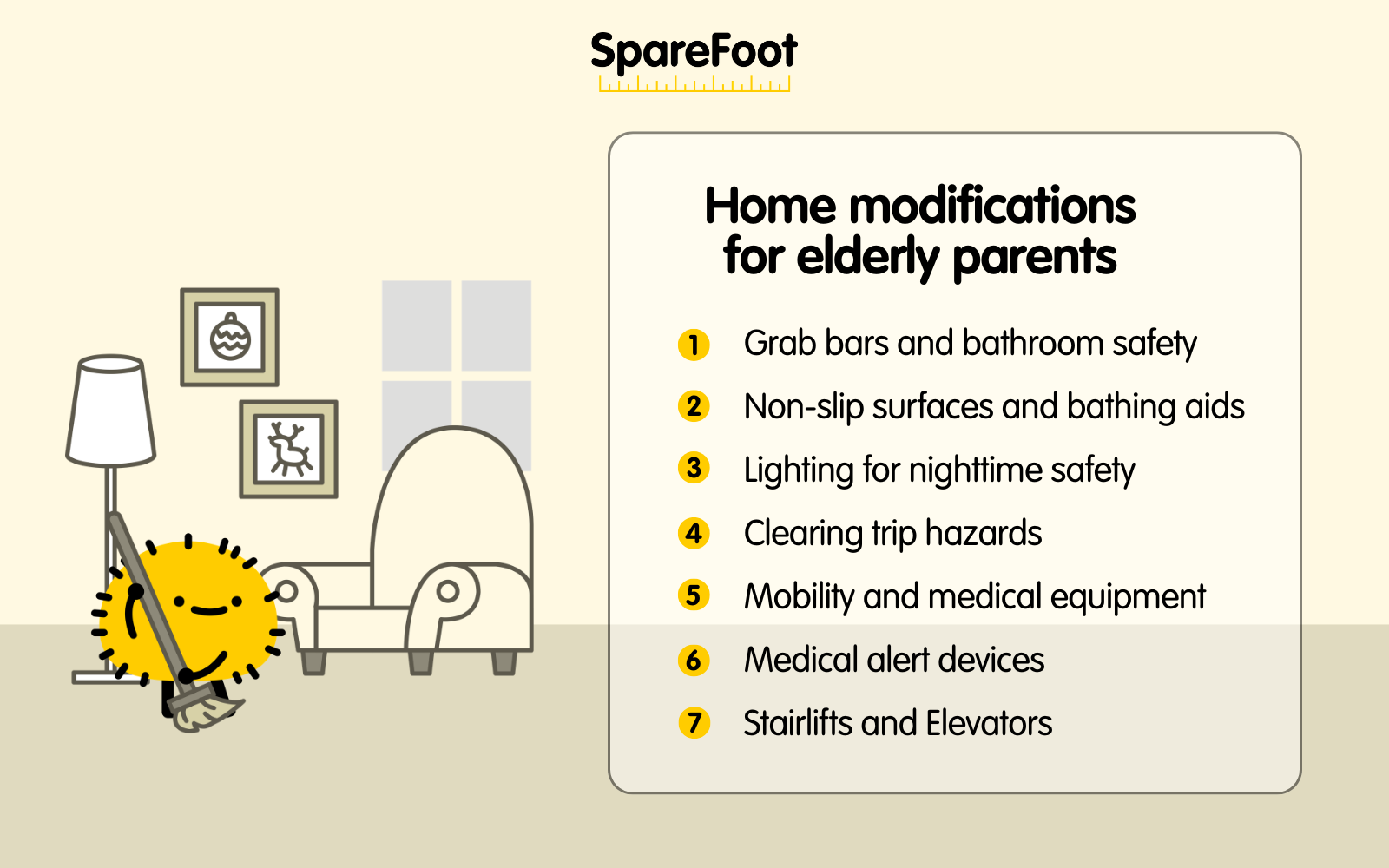
There are lots of families out there who are underprepared, either winging the home modifications or postponing them until the elderly parents’ needs surface. This often leads to a period of frustration for the parent, who feels cut off and whose autonomy depends on construction schedules.
There are other home renovations you can make that increase your storage space, but you’ll want to prioritize safety and mobility at this stage. After all, a nearby storage unit can pick up the storage space slack. But nothing can substitute for modifications that increase your parents’ mobility, autonomy, and sense of safety.
We suggest doing as many of the home modifications as you can before your aging parent moves in, so they’re moving into a setting they can navigate.
If it’s an option, a ground-floor bedroom and bathroom lightens your safety modification workload and cuts down on the risks of falls and overstraining.
From there, focus on straightforward, high-impact accessibility devices and accommodations, starting with the ones that accommodate your elderly parent’s particular needs.
Here are some accessibility accommodations to consider beforehand:
Grab Bars and Bathroom Safety
- Bathroom grab bars near the toilet and in the shower are one of the most common and most effective home modifications you can make
- Grab bars are inexpensive to install compared to almost anything else on this list.
- Prioritize the shower entry and the area right next to the toilet, as these are where most bathroom falls happen.
- A contractor can anchor bars directly into wall studs for a safer weight-supporting infrastructure.
- Avoid suction-mounted grab bars marketed as a quick fix, since they often won’t hold up when your elderly parent puts their full weight on them.
Non-Slip Surfaces and Bathing Aids
- If you need an easy win to break the lack of motivation, anxiety, or procrastination seal, putting in some bathroom add-ons is a good starting point.
- Install non-slip mats inside and outside the shower or tub, a raised toilet seat, and a shower chair.
- All of these amenities are inexpensive, easy to find, and take no time at all to install
Lighting for Nighttime Safety
- Install nightlights in hallways and bathrooms
- Motion-sensor lighting provides hands-free illumination, adding convenience and lessening your elderly parent’s burden
- Lighting is a must-have for midnight trips to the bathroom, which is one of the times when your senior parent is most at risk of falls
- Motion-sensor options are worth the small extra cost, since they alleviate your parents from having to fumble for a switch in the dark
Clearing Trip Hazards
- Free your parents’ pathway from loose rugs, trailing cords, and general clutter
- Trip hazards can be a common cause of falls at home, and the cheapest and easiest to fix.
- Walk the path your parent will use most (bedroom to bathroom, bedroom to kitchen) and make sure it’s clear.
Space Planning for Mobility and Medical Equipment
- A walker, a wheelchair, or oxygen equipment all need more than just a corner to be pushed into, but a significant clearance to maneuver.
- Measure doorways and hallways, planning for the equipment your parent actually uses
- Rethink furniture placement in the rooms they’ll spend the most time in before move-in day, so their path is clear when they arrive.
Medical Alert Devices
- Medical alert devices can save lives, regardless of your parents’ current health, especially during the hours when you’re not home.
- Lots of the more modern options include fall detection
- Many modern alert devices are cell-based and don’t require a landline. They can sync to smartphone apps that send alerts, location, or fall-detection notifications to a family member’s or caregiver’s phone.
Stairlifts and Elevators for Multi-Level Homes
- If mobility on stairs is a concern, an automatic stairlift can make a two-story house workable again for a fraction of the cost of a full renovation.
- For larger budgets or longer-term needs, a home elevator is a more substantial but more permanent solution.
- The National Resource Center on Supportive Housing and Home Modification is a solid starting point for local resources and guidance on what modifications actually help versus what’s marketed.
No Spare Room? Renovation and Conversion Options
If you don’t have a spare room ready, look at in-law suite conversions, or a garage or basement conversion. Home renovations and home remodeling projects like these often mean displacing furniture and boxes for weeks or months.
You can book a temporary storage unit to both protect your belongings from dust and paint and help clear some space for contractors. The extra space often means they can work faster.
Downsizing Your Parents’ Home With Compassion (and a Plan)
Downsizing your parents’ family home isn’t just a logistical task to cross off your list. It’s an emotional journey, too. Having a thoughtful plan put together ensures that both facets are given space and approached with a compassionate attention to detail.
- Work together with your parent to organize the items into categories instead of by room.
- And you’re not just downsizing; you’re decluttering before your move.
- That means you take all your elderly parent’s pots and pans out and touch each one of them.
- Put each pan in one of four piles: keep and bring into your home, store, donate or sell, and family heirlooms.
- We say pots and pans because you want to start with the categories that have fewer sentimental items. Collectibles, photo albums, and cherished keepsakes can wait.
- Once all your pots and pans are in one of the four piles, go through each pile.
- Pack the things that will go to your home and into storage separately.
- Anything you’re selling or donating can go straight to the donation center or get posted on an online marketplace. Some charities will even pick up your donations.
Give yourself and your parent permission to slow down on the sentimental stuff. This is where the storage pile comes in handy. Putting things you’re not sure about keeping or getting rid of in a storage unit buys your family some time.
You and your parent are both coping with some large-scale life changes here. There’s no reason to force a purge under deadline pressure and add grief and guilt to an already stressful situation.
But at the same time, there’s a proven link between clutter and mental health. A storage unit is the middle path, avoiding clutter and ensuring you’re not making rushed choices about giving things away.
If decluttering under pressure is adding to the mix or makes it worse — a storage unit buys the family time to decide without the clock forcing bad calls.
Not everything needs the same type of storage.
Photos, documents, and wood furniture are sensitive to extreme temperature changes and humidity swings. And climate-controlled storage prevents just that. It earns a slight hike in price by regulating and maintaining ideal temperature and humidity levels year-round.
Other items only need short-term storage. For example, if you’re staging the house for sale, or waiting on a sibling’s larger home to free up while your parent stays with you, you don’t want to get stuck in a lease.
But if you’ve inherited family belongings neither you nor your parents use on the reg, or don’t want to put a timeline on getting rid of stuff in storage, a long-term storage lease typically saves you some money.
Set Up Their New Living Space Before They Arrive
Creating a sense of familiarity from the get-go can really help smooth your aging parent’s transition. Try to incorporate elements from their previous home, like using the same bedspread, sticking their favorite end table, reading lamp, or chair in the space, and hanging up family photos.
Make sure to stock the room with the everyday essentials they’ll need before move-in day. That way, they feel like they can tend to themselves as soon as they arrive.
Keep the stuff they use frequently easy to reach and clearly labeled. Everything feels unfamiliar when you’re settling into a new home, even if it’s your kid’s place. And little inconveniences can quickly add up for someone who’s already adjusting to a life change this big.
Moving Day: Build a “First Day” Kit

Pack your parent a “First Day” moving kit and keep it separately from every other box so it never accidentally ends up on the truck or, worse, in a storage unit. We suggest keeping it with your parent in the cab or in whatever vehicle they ride in from their old place to yours.
A solid “First Day” kit for an elderly parent should include:
- Medications and medical documents
- Toiletries and a change of comfortable clothing
- ID, Social Security card, and insurance cards
- Chargers and any medical devices
- A few comfort items, like a favorite photo, a blanket
- Pet supplies, if needed
The First 90 Days: Building New Routines
The adjustment period isn’t just for your aging parents. In fact, it impacts the whole household. And if you’re in the sandwich generation, it’s only healthy for you to consider how it affects your kids.
You can help everyone adjust by building healthy routines. Establish predictable mealtimes and TV routines. Draft a call schedule for your parents to talk with their friends and other relatives, so their social fulfillment doesn’t depend on the people living in the house.
A clear system means clear expectations. And that helps everyone find their footing faster than improvising day to day.
Help your parent build a social network in the senior community in the new area. A local senior center, adult daycare program, faith community, or hobby club can make someone who’s just lost their old neighborhood and routines feel supported.
Plan your parents’ transportation needs far in advance. Coordinate with your siblings, housemates, or senior care workers to figure out early who’s driving to appointments, activities, and social visits, and whether public or senior transit options exist near you.
Small rituals like a regular family dinner, with accessible seating tailored specifically toward your parents’ mobility needs. If your parent uses a wheelchair or walker, putting in the effort to confirm ahead of time that the family outings happen at places that accommodate them can make them feel welcomed.
Around the 30-, 60-, and 90-day markers, where the whole family, including your elderly parents, siblings, caretakers, drivers, and your children, can speak freely, with respect and compassion, about how the previous month has felt. Make an effort to adjust the schedule and shift responsibilities as needed.
At the 90-day meeting, revisit the moving conversation you had at the very start. Is everyone happy with the arrangement? Are your parents’ needs being met, or would a senior living community make them more comfortable? You can have a senior relocation specialist sit in on the 90-day meeting to demystify the process, answer questions, and help your parent explore their options.
Take Care of Yourself, Too
Caregiver burnout is no joke. It tends to creep up rather than hit you all at once. So start looking for the earliest signs:
You’re not betraying your parents by acknowledging these signs. Calling in the senior care reinforcements isn’t all or nothing. Respite care can step in for a few days a week. And you can rotate some of your responsibilities with your family members. But you want to lighten your load now, before you reach a breaking point.
Building a support network doesn’t mean starting from scratch. Organizations like the Family Caregiver Alliance offer support sessions and practical caregiving tips from people in the same position, and sites like Caregiver Relief and Memory Care Consulting compile guidance specifically for families managing cognitive decline or dementia care at home.
As soon as you notice the strain impacting your well-being in any way, consult a therapist or psychologist.
There are family mental health professionals who can facilitate group work involving the whole family. But we suggest having your own personal therapist who treats only you and can help you track changes in your stress and behaviors.
Remember, looking after yourself is part of caretaking for your parent.
How much notice should I give before my elderly parent moves in?
You should give three to six months’ notice before an elderly parent moves in, when you can help it, and the move isn’t happening in a crisis. That gives you time to handle legal paperwork, line up home modifications, and have the harder family conversations without rushing them.
What should I do with my parents’ furniture if it doesn’t fit in my home?
If your parents’ furniture doesn’t fit in your home, sort it into keep, store, sell, and donate categories before the move, not during it. A climate-controlled storage unit is a practical middle ground for pieces you’re not ready to part with but can’t fit in your home, especially furniture with real sentimental or resale value.
Is climate-controlled storage necessary for family heirlooms?
Climate-controlled storage is necessary for family heirlooms like paper documents, photographs, vinyl records, artwork, books, jewelry, and wood furniture. Temperature and humidity swings cause real, often irreversible damage over time.
How do I handle disagreements with siblings about a parent moving in?
Handle disagreements with your siblings about a parent moving in by naming the likely friction points in a family meeting before they happen. Discuss the division of caregiving duties, financial contributions, and differing views on your parents’ independence before the move happens. Even an uncomfortable family meeting is easier than resolving resentment after the fact.
What government or financial changes happen when a parent moves in with you?
The government or financial changes to be aware of when a parent moves in with you start with updating their address with Social Security, Medicare, pensions, and banks. Depending on your finances, you may be able to claim them as dependents for tax purposes, which can open up credits or a dependent care FSA if you’re paying for care. Talk to a tax professional about your specific situation.
Should I hire a moving company or handle it myself?
Hiring a professional moving company for your parents’ home involves decades of belongings and complicated logistics. But have some friends and family present to help and make it feel more personalized. Vet movers carefully to avoid scams targeting older adults and their families.
Where can I find local senior care resources if I don’t know where to start?
You can find senior care resources using the Eldercare Locator, a public service of the U.S. Administration on Aging. It’s a tool connecting families to local Area Agencies on Aging, which can point you toward everything from adult daycare and transportation programs to home care aide referrals and caregiver support groups in your parents’ area.
How to Prepare for an Elderly Parent Moving in Using SpareFoot
By now, you should have a pretty solid idea of how to prepare for an elderly parent moving in.
As we mentioned, you want to be honest about what you and the people in your household can provide, and how it stacks up to what your elderly mom or dad needs. Moving an elderly parent shouldn’t just be following a household transition or social expectation.
That said, multigenerational households are becoming more and more common for a reason. Lots of families report stronger family bonds once the adjustment period passes.
If you’re in the sandwich generation, caretaking for both your parents and your kids, it goes beyond the obvious connection you may already have with your parent. There’s an intergenerational bond that can form between them and your children.
But be honest. You have your own household and family dynamics to maintain, and it’s okay to ask yourself tough questions about whether moving your parents in will change them in unhealthy ways. Talking to a therapist who specializes in family systems can help.
And even after you decide that moving your elderly parents in with you is a good fit, the planning is a necessary part of making the transition.
An elderly parent moving in with their adult child is a life transition, with complex logistics and complicated emotions. And it goes a lot smoother when you plan for both.
They may have some belongings you can’t fit at your place. And there may be some things that they don’t necessarily use in their day-to-day, but carry enough sentimental weight to make getting rid of them a decision they or you aren’t ready to make.
Take your move slowly, one box at a time. And be kind and gentle toward yourself throughout the process.
There may be some boxes and sentimental items you’re not ready to unpack just yet. There may also be some things you can’t fit into your home but aren’t ready to part with, and that’s fine.
You can rent a storage unit on a month-to-month contract; you can renew it and keep it for as long as it takes to heal. There are some things about your family you can’t control. But a self-storage unit can at least empower you to take control of your timeline.
Adjusting to living with an aging parent takes time. The amenities and storage features you need to keep your belongings safe and sound until you’re ready to go through them vary depending on what you’re storing. Not every storage facility offers climate-controlled units, for example.
But you also don’t want to be adding stress when using storage for life transitions by driving across town every time your parent needs something.
That’s where we come in.
Simply use our handy SpareFoot Storage Unit Locator Tool to find a storage unit where your aging parent can keep their things that’s close to their house. Our tool searches the units in your area and tailors the results based on the detailed search parameters you set.
You can use your own car to move your parents’ things into the storage unit piece by piece. You can organize the stuff with your parents, deciding what needs to come to the house with them and what can stay in storage.
Then, on moving day, you use your moving truck or pay the moving company to load up the already packed essentials from the storage unit near your parents’ house to the unit near yours.
Unload the truck into your new storage unit and return it as soon as possible to save hundreds on hourly labor. You can move the essentials into the house immediately.
Everything else can chill in the storage unit until you need it. A storage unit lets you move your parents’ belongings into your house with your personal car, box by box, at your own pace.
Moving your parents in with you is expensive enough without factoring in a last-minute move. SpareFoot even has an additional search tool that finds storage deals, like your first month of storage, for free.


Michael Ta’Nous
Michael Ta’Nous is a full-time writer who works and lives with his wife in Taos, New Mexico. “Mikey” spent his early twenties living either out of a van as a touring musician or out of a backpack on motorcycle trips writing from cafes–these rigorous adventure years polished him into a master packer. In addition to managing storage units full of catering supplies and outdoor gear professionally, Michael has used storage units as a band rehearsal space and a motorcycle garage.