
KEY TAKEAWAYS
▸ Mindful spending and conscious consumption address the psychological roots of overconsumption by building awareness of the emotional triggers and cultural conditioning that drive our impulsive purchasing decisions.
▸ The dopamine shopping cycle creates a repetitive pattern of anticipation, acquisition, and disappointment, leading to clutter and financial stress without lasting fulfillment.
▸ Conscious consumers can research brands, buy local products, choose B Corp-certified companies, and shop secondhand to align their purchases with their environmental and social values.
▸ Strategic use of self-storage can support minimalist lifestyles by enabling seasonal rotation of items and providing space for repair projects while allowing you to maintain a decluttered living space.
▸ The financial benefits of mindful spending include streamlined planning, increased savings, improved debt management skills, and an enhanced ability to make objective financial decisions aligned with your personal values.
With the economy getting more and more volatile, phrases like mindful living, mindful spending, and minimalism are trending.
Minimalism is getting rid of all possessions except for the bare necessities, and that often includes downsizing into a tiny home, trailer, or converted shipping container. The goal with extreme minimalism is to minimize the cost of living, typically to have more free time, to save resources for vacations, etc.
There’s no doubt that the mental and physical clutter our consumeristic culture encourages has a proven impact on well-being.
That said, shifting to an extreme minimalist lifestyle for consumeristic reasons fails to address the underlying psychology at the core of our overconsumption crisis.
As writer and thinker Idries Shah discussed, one can be greedy for anything, including spiritual knowledge, health, and enlightenment, but the greed itself is self-destructive regardless of its aim.
In some cases, we can be greedy for simplicity, minimalism, and more free time to consume vacation experiences. But the greedy, consumeristic mentality stays intact or is even reinforced, despite the apparently drastic changes.
But given the clear link between clutter and mental health, a shift in lifestyle and mentality seems more than just appealing; it seems necessary. That’s where mindfulness comes in.
If we can be conscious of the consumeristic mentality our cultural conditioning has instilled in us, we can make more intentional choices.
The choices can include what to buy, what to keep at home, what to sell/donate/recycle/trash, and what to store in an off-site storage unit. We can call this alternative, less extreme, and more intentional approach mindful living, mindful spending, or conscious consumption.
This article compares consumer psychology to the psychology of mindful living.
We’ll take an honest look at the barriers to conscious consumption. We’ll explore how to become a minimalist with an emphasis on mindful spending, starting with downsizing and decluttering techniques, and the conscious use of storage.
We’ll also reveal how SpareFoot can help you find an affordable storage unit in your area that has all the amenities you need to start your journey toward a decluttered space and a liberated mind.
First, let’s take a closer look at conscious consumption. What exactly does it mean to be a conscious consumer?
What is Conscious Consumption?

Conscious consumption or conscious capitalism is making intentional purchases informed by an awareness of the cultural, social, psychological, and environmental impact our consumer choices have. Conscious consumers use critical thinking and research products, brands, and ethical sourcing of ingredients to ensure their purchases support sustainable and ethical practices.
The United States is a consumer society, where we essentially vote with our dollar. Our culture defines us, and we define our personal values by how and what we consume.
- Conscious consumers looks at currency as electrical current, using their money to empower brands that actualize their values.
- They may favor brands that use fair trade practices by examining product labels and looking for Fair Trade Certified symbols.
- They may favor brands that use quality or organic ingredients, sustainable waste disposal practices, etc.
- While critics of consumerism note that capitalism puts the burden on the consumer by design, conscious consumption is a way of flipping the narrative, empowering the people, and hitting brands, sponsors, and cooperations where it hurts them most–their profits.
Some argue that human beings are consumers by default, as consuming food, clothing, shelter, and tools has always been in our nature. But in a consumeristic capitalist society, consumption is for profit. So there’s an incentive for corporations to influence us – through marketing messaging and media– to consume more than we need.
- The Second Industrial Revolution significantly altered our consumption patterns by mass-producing goods and by manufacturing a variety of similar goods for us to choose from.
- Mass-produced goods don’t last as long as handmade, quality products, but they come in a colorful variety.
- For example, instead of buying one pair of handmade slippers that last your whole life, you can buy five cheap pairs of slippers in different colors, and five different pajama sets to match – but because they’re mass-produced from cheap materials, they’ll only last a year or two.
- And the companies producing these goods pump out influential marketing campaigns that not only influence people to buy more than they need, but also condition us to satisfy spontaneous desires through purchasing.
- But because our need for dramatic stimulation is never gratified, the bliss wears off in a matter of hours, and we’re back to chasing the release that never comes by buying more stuff.
Conscious consumption not only offers us a way to shift our social and cultural focus, but a shot at rewiring our own self-limiting and even self-destructive mentalities. Let’s take a closer look at consumer psychology and the alternative: mindful spending.
How Consumer Psychology Works Against Conscious Consumption and Mindful Spending
Whether we grew up in the United States or came here from another culture, the social status quo that surrounds us is consumerism. Our identity is often connected with what we spend our money on, where we buy it from, and the why we use to rationalize our purchase.
Before we move into more conscious consumption habits, it’s critical to understand how consumer psychology works. Even mindful living has become a marketing demographic. True consciousness requires more than just switching from corporate bread to a local bakery. It takes a conscious and determined effort.
We have to first accept that none of us are immune to consumeristic conditioning – consumerism is the nucleus of our social structure. Then, we can illuminate how the conditioning influences our consumption habits with the light of self-awareness. But in order to do that, we have to understand the mechanisms of consumer psychology.
Let’s start by examining the modern Western existential and identity crises, which leave us vulnerable to what’s called the Dopamine Shopping Cycle.
The Post-Modern Existential/Identity Crisis

Before we get into the dopamine shopping cycle that leads to overconsumption, let’s take a look within and see why we’re so susceptible to consumer marketing. Once we identify it, we become aware of how consumer messaging triggers the purchasing cycle.
- Sense of Deficiency or Lack of Fulfillment: The cycle starts with a general sense of emptiness. There are many theories and techniques centered around understanding and coping with modern existential dread. Multiple philosophical thinkers and Self psychologists tie it directly to our consumeristic culture:
- Our cultural and social identities are tied to superficial and impermanent aspects like our achievements/failures, possessions, and reputation.
- And since we know deep down that none of these things expresses our True Self, our True Self feels unseen and unappreciated, no matter how much we gain and accomplish.
- The lack of True self-recognition and actualization results in a sense of non-existence and emptiness.
- The Drive for Dramatic Stimulation: The threat to our identity can trigger our survival instincts, which are focused on providing food, water, clothing, and shelter – the drive to consume. Because our culture defines us by our consumption habits, and because our sense of self is what’s deficient in the first place, we attempt to fill or distract ourselves from the lack by seeking out dramatic stimulation. This general state makes us susceptible to the dopamine shopping cycle.
- Rewards and Punishment as Social Conditioning: Many cultural and social belief systems, past and present, use systems of rewards and punishment to maintain order. While sociologists examine these systems on a large scale, psychologically oriented thinkers note that for most of us, it starts in our family of origin. From a young age, we learn to expect rewards when we do something “good” and punishment when we do something “bad.” This mental mechanism has some pretty heavy implications for our adult behavior:
- We’re trained to seek reward and avoid punishment.
- We associate any form of suffering with being punished, and any dopamine release with reward.
- The result is that we try to use dopamine to relieve the tension of suffering, including the deficient sense of non-existence.
The Dopamine Shopping Cycle

Now that we know why we’re naturally primed to consume, let’s examine the inner mechanics of the dopamine purchasing cycle. Clearly seeing the patterns at work within us can help us cultivate the determination and Self-knowledge required to resist.
- Anticipation: Seeing an ad on our social media platforms, TV/streaming services, or online, an influencer promotion, walking by a window display, or browsing your favorite retail store creates a dopamine spike, a shot of the dramatic stimulation we crave. The spike can even trigger fantasies of potential rewards, including exaggerated opportunities and positive attention of any kind.
- Example: You see an Instagram ad for a new pair of shoes. You visualize yourself wearing them, your partner or crush complimenting them and asking you out, and your co-workers respecting or fawning over you more.
- Acquisition: While still under the influence of the dopamine hit and the expectation of having your anticipation fantasy fulfilled, you purchase the item. Buying the item adds to your dopamine release.
- Example: You order the shoes. You’re excited to receive them, and your fantasies and expectations continue to provide dramatic stimulation until the shoes arrive.
- Ownership: Once you own the item, your dopamine levels stabilize or even drop. The reality of owning something is often physical work and financial maintenance, or the consequences of neglect. Even a car in storage needs to be constantly washed and tuned to stay as smooth as it looked and drove in your head before you bought it. A fancy dress needs to be dry-cleaned. The reality of owning something often doesn’t match the fantasy.
- Example: You’re partner and coworkers compliment your new shoes and then immediately go back to what they were doing. You’re life and sense of self immediately return to where they were right before you bought the shoes.
- Sense of Deficiency: With our dopamine levels collapsed and our fantasies unfulfilled, we’re right back where we started. The lack of positive attention and the routine maintenance and consequences of neglect associated with owertship can even feel like punishment, triggering the desire for dramatic stimulation and search for reward that starts the cycle all over again.
- Example: To cope with the deflation triggered by the new shoe let down experience, you scroll on Instagram and see an advertisement for a new pair of pants. You picture yourself wearing them, and the process starts all over again.
This cycle isn’t limited to material possessions like unwanted clothing, vehicles, interior design, etc. It can be triggered by picturing yourself with a specific beer in your hand and feeling as buzzed as the person in the commercial.
But it can also be caused by picturing yourself taking a new vitamin supplement and feeling happier and healthier than ever before. It could be imagining yourself as fit as a supermodel in the gym commercial that tempts you to join the gym.
The target of our consumerist appetite varies depending on our respective personalities and self-images. But what’s consistent is the fantastical expectation of fulfillment and reward. Flash sales and deal countdowns add a sense of urgency. And we don’t want to lose the temporary dopamine release. So we click Buy Now and drink in the anticipation while it lasts.
And so far, we’ve been talking about the average person’s mentality in a consumer society. Some people live with a genetic and neurochemical condition called Reward Deficiency Syndrome, where:
- Their dopamine receptors never register the reward, even temporarily, and thus are constantly chasing a high that never comes.
- People with Reward Deficiency Syndrome develop shopping addictions and other compulsive behaviors.
- If you’re living with Reward Deficiency Syndrome, you may need the support of professional help, as switching to conscious consumerism can just lead to a different flavor of the same compulsive shopping behavior.
- Resources like Mental Health America can help support those living with Reward Deficiency Syndrome.
We accumulate more and more clutter in our home as we repeat the Dopamine Purchasing Cycle. So why don’t we just get rid of the stuff we’re not using? Once again, we’ll have to examine our own mental processes as we move toward a more ethical consumerism.
Emotional Overspending and Clutter
You can gather from the section above how being emotionally triggered by life situations can intensify the Dopamine Shopping Cycle.
But even after you recover from this state, or decondition yourself from the purchasing cycle altogether, you’re left with the accumulated clutter of stuff you never needed. The emotional association of positive and negative memories and emotions with objects can cause us to avoid either organizing or getting rid of unused items:
- When we touch or even just look at an item associated with either a positive or negative emotional memory, it triggers the emotional flavor of the memory, changing our emotional state.
- Positive triggers bring back pleasant memories while negative associations target unpleasant or unsettling flashbacks.
- We may avoid getting rid of items we don’t need if we enjoy indulging in the positive emotions we associate with them.
- We may avoid touching, looking at, or even thinking about items that cause negative flashbacks.
Regardless of the specific emotional effect, if we hold onto items we don’t need as a means of either clinging to or avoiding the memory’s stimulation, we’ll end up with a cluttered space, which can lead to even more avoidant behaviors.
Conspicuous Consumption

Another bad consumption habit we need to put in the spotlight of our consciousness is conspicuous consumption.
Wikipedia defines conspicuous consumption as a term coined by sociologist and economist Thorstein Veblen to explain the consumeristic habit of buying and using goods of a higher-than-average quality, price, or in greater quantity… as a public display of the economic power, income, or accumulated wealth of the buyer.
Veblen’s social science system of monitoring consumption habits also included consumeristic conditions like invidious consumption: the gaudy and public consumption of goods intended to provoke the envy of other people. And conspicuous compassion: the gaudy and public use of charity to enhance the reputation and social prestige of the donor.
Becoming increasingly more aware of these behaviors within ourselves can help us curb the urges to participate in them.
It’s no accident that words like mindfulness and consciousness are attached to behaviors like mindful spending and conscious consumerism. Both of these words are connected to the concept of awareness. The reason we’re showcasing the consumeristic conditioning society and culture imparts onto all of us is to bring awareness to our habits.
As we become aware of these patterns, we start to develop the will required to behave in new, less limited ways. Reading this section and familiarizing yourself with the general mechanics was an effective first step. But how these patterns manifest in our unique minds varies.
Let’s take a look at a few more actionable steps we can take to build awareness of our own personal consumer psychology.
Building Awareness Before Changing Our Overconsumption Behavior
Before we can shift our consumption habits, we need to become aware of the driving forces behind them. If we try to pivot our consumeristic aim toward mindful living before we become aware of these tendencies, mindful and healthy living can become a form of conspicuous compassion or yet another quest for dramatic stimulation.
Here are three short steps we can take to become more aware of our spending and overconsumption habits.
- Step 1: Identify Personal Triggers- By recognizing the physical, mental, and emotional states and scenarios that trigger the impulsive urge to buy, we can address the cause rather than the symptom. I’m a big fan of talking to a therapist about the mental blocks and holes that limit our autonomy in daily life. You can also try keeping a journal that tracks the emotional states you’re in before, during, and after you purchase new items. Be as honest as you can.
- Step 2: Use the 24-Hour Cool Off Rule- When you get the spontaneous urge to buy something, pause for a full 24 hours. Keep track of your shifting emotional states over that time, and you’ll see how the dopamine rush that started the process dies out if you don’t give in to it. After 24 hours have passed, when the high has worn off and you’re in a more rational state, decide if you really need the item or if a desire for stimulation is driving the decision.
- Step 3: Track Your Spending: In addition to tracking your emotional curve when it comes to spontaneous spending urges, track every dollar you spend for a few weeks. Make a table with four columns. Column one lists what you bought, and column two says how much you paid for it. In column three, name the brand that made the product or sold the food. And in the fourth column, answer yes or no to whether or not the brand’s practices align with your values.
After using these practices to build an awareness of your shopping habits and the emotional triggers behind them, you’re ready to shift from overconsumption to conscious consumerism.
How to Become a Minimalist: The Pillars of Mindful Spending
Now that we’ve examined the inner mechanisms behind our shopping habits, we can start changing our behavior. As VCU News reported after an interview with VCU sociologist Meredith Katz last year,
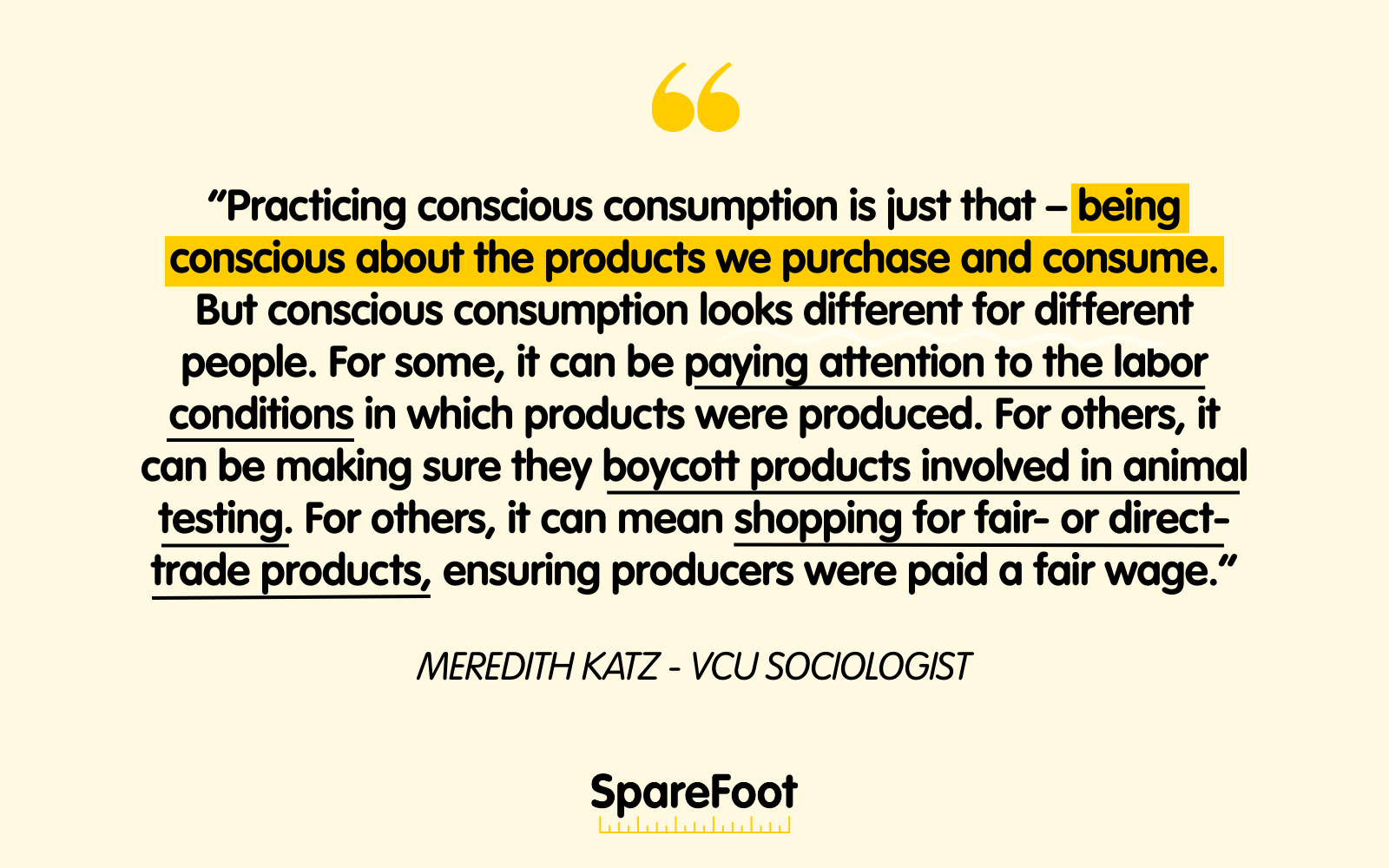
Among other factors, technological connectivity, imperial expansion, and the cross-cultural transparency social media provides have led to a more globalized world.
While there are a lot of pros stemming from our increasingly connected network, it also puts us further out of contact with the people who design and produce the products we buy.
Mindful spending can feel crushing in the beginning, since you’re only one person. But keep in mind that the lofty goal of changing the world can be as much of an escape from our individual agency as nihilism, and the two tend to form a polarity of all-or-nothing thinking.
- Conscious consumption starts from a place of being conscious about our own ecological footprint and who we’re giving money to.
- We may not be responsible for large-scale environmental and social damage, but we’re also more responsible than most of us believe.
- In the early stages of mindful spending, we’re simply trying to support what we believe by withdrawing from supporting mentalities we disagree with.
All that said, we often have more of an influence in our immediate circle than we think we do. Trends typically start in a single circle, and in the age of social media, trends can spread faster and to a wider demographic than we can predict.
There’s something inspirational about someone brave enough to stand on their truth, and those they inspire tend to prop them up. Or, as VCU puts it:
“If we look at history… Some of the largest social movements – from the Boston Tea Party to the Civil Rights Movement […] – have had an element of conscious consumption. In each of these cases, consumers knew that where they spent their money mattered, and so they organized boycotts and buycotts (intentionally purchasing) accordingly.”
So with our personal truth and self-empowerment in mind, let’s run through the pillars of ethical consumerism:

Lower Your Rate of Consumption
The primary goals of ethical consumerism are to be more aware, intentional, and conscious, and to cut out purchases you don’t need. Saving money is a byproduct, but living a more intentional life and deepening our self-awareness are the real gems we’re mining for.
By consuming less in your day-to-day, you become more in tune with your own intrinsic value. And by monitoring and reducing your spending habits, you become aware of why you buy and how much you actually use.
You can also schedule deliberate No Spend Days. A No Spend Day is exactly what it sounds like, a day where you commit to spending no money.
No spend Days not only help you save money, but they also help you master your cravings and impulses and assess your spending habits and financial priorities.
A No Spend Day can be a specific day of the week, as in your day off, where you fill your gas tank up the day before, and then do a free activity like going on a hike or taking your dog or kids to the park.
You can also plan and schedule a no-spend challenge, where you set aside a specific week where you only buy essential items.
Research the Brands, Ingredients, and Retailers Before You Buy
We encourage you to use social media, company websites, and online reviews to research not just the brand whose product you’re planning to purchase, but the supplier of their ingredients, and the retailer you’re buying the product from.
Remember, the goal here is consciousness. You may still have to purchase some things from brands and retailers whose values don’t align with yours, especially in the early stages. But you’re not turning away from the reality of what you’re contributing to. And as soon as you find an alternative option, that knowledge will inspire a seamless transition.
Now you understand why consuming less is the first step – if you’re consuming a large quantity and a wide variety of goods, researching everything you buy is time-consuming and painstaking. That said, the opposite is also true. Refusing to buy something until you’ve had a chance to look into the brand and sources of its ingredients will prevent impulse spending.
Avoid Greenwashed Products; Check for the B Corp Certification
Some brands employ a marketing tactic the conscious consumption community calls “Greenwashing.” Brands may use slogans like “eco-friendly” or “all-natural” that don’t actually mean anything or require validation. Greenwashed products will use green logos with leaves or trees or other nature-associated images to imply that their product has a low environmental impact.
To help conscious consumers identify brands that actually support green consumerism, B Lab was formed. B Lab is a non-profit group that investigates brands and assesses their level of social responsibility and environmental impact.
Only Certified B Corporations are legally allowed to put the B Corp Certified logo on their products. And to become a B Certified Corporation, a brand has to prove to B Lab that they “consider the impact of their decisions on their workers, customers, suppliers, community and the environment.”
You can also avoid supporting greenwashed brands by looking for other widely recognized certifications, such as Climate Neutral, Leap Bunny, and Forest Stewardship Council.
Buy Local Products
Remember, it’s not just the brands whose products you support that make a social, cultural, and environmental impact, but it’s also where you buy them from. Conscious consumers buy as much produce as they can from their local farmers’ market and avoid corporate chains.
Eat at locally-owned restaurants, prioritizing businesses where the owner is actually hands-on in the day-to-day operation to avoid supporting non-local investment companies.
Shop at mom-and-pop clothes and hardware shops rather than corporate retailers, and buy clothing, jewelry, and wall art from local artists. Not only does shopping for products locally reduce your carbon footprint, but it also keeps your money in the local economy, where it can have a positive impact on your daily life.
Shop and Donate to Secondhand Stores
Another great way to support green consumerism is to buy used clothing, books, appliances, and home decorations from thrift stores, online resale outlets, consignment stores, and garage sales, on a need-only basis.
You can contribute to upcycling and limit the support for corporate retailers and consumeristic manufacturing by organizing clothing swaps within your community.
If you’re wondering how to become a minimalist, donating anything you don’t use or don’t need to secondhand stores is a great way to downsize while also helping others in your community meet their needs outside the production/retail consumer cycle.
Repair, Repurpose, and Use Self Storage to Shrink Your Environmental Impact
Conscious consumerism requires an awareness of your ecological footprint. The more items you can keep off the growing trash heaps in our landfills, the less of an impact you’re making.
This means pausing before you trash broken clothing, electronics, and children’s toys and seeing if you can repair them. Or you can try to repurpose them in some way, even if it’s in an arts and crafts project or as a decoration.
That said, you don’t want to turn your home into a cluttered storage space while you figure out what to do with every broken item, especially if you’re in the process of decluttering and downsizing. This is where a basic storage unit can really come in handy for minimalists:
- Keep anything you don’t use on a regular basis or need to repair in storage.
- Once a year, reorganize and take an inventory of everything in your storage unit.
- Donate anything that you haven’t touched or thought about in over a year.
There are even some charities that pick up donations and will pull their truck right up to your storage unit and take anything you don’t use off your hands.
These pillars of mindful spending may seem like a lot at first, but you don’t have to employ them all from day 1.
Focus on integrating one or two of these into your shopping routines. Once you’re habits have stabilized, add a few more pillars into the mix, and before you know it, you’ll be a full-fledged conscious consumer.
It may seem intimidating to get started, but you’re not alone – there are lots of resources available. Let’s take a look at some other ways a storage unit can help ease your transition into mindful living.
How Eco-Conscious Self-Storage Can Help With Mindful Living
One of the most common misconceptions about minimalism is that a storage unit is by default excessive.
Sure, a storage unit filled to the brim with accumulated items you don’t use and won’t ever repair or sell may be overindulgent. But using an affordable storage unit as a tool for rotation is quite common among people who have downsized their home to the bare necessities.
You can keep your winter clothes and ski gear in storage in the summer, for example, and then swap them out for your mountain bike and summer clothes when winter arrives.
Once per season, you can go through your storage unit and donate or sell things you haven’t used since the same time last year. For example, if it’s time to unpack your winter gear and you realize you haven’t used those old snowshoes since three winters ago, it’s time to donate.
Minimalists use self-storage to reduce waste and clutter in their homes. And booking a local storage unit that already exists makes way less of an environmental impact than building a new storage structure at home.But not all storage unit practices are created equal. Mindful living requires eco-friendly storage techniques. Let’s take a look at a few:
- Avoid single-use plastic tubs or cardboard that breaks down over time: Replacing materials that wear out quickly adds to your carbon footprint. Eco-conscious storage means choosing environmentally friendly storage containers made from upcycled or recycled materials.
- Choose a storage company that’s mindful of its footprint: Lots of modern storage facilities use LED lighting, solar panels, and energy-efficient designs. Now you’re supporting a storage company that makes eco-conscious decisions.
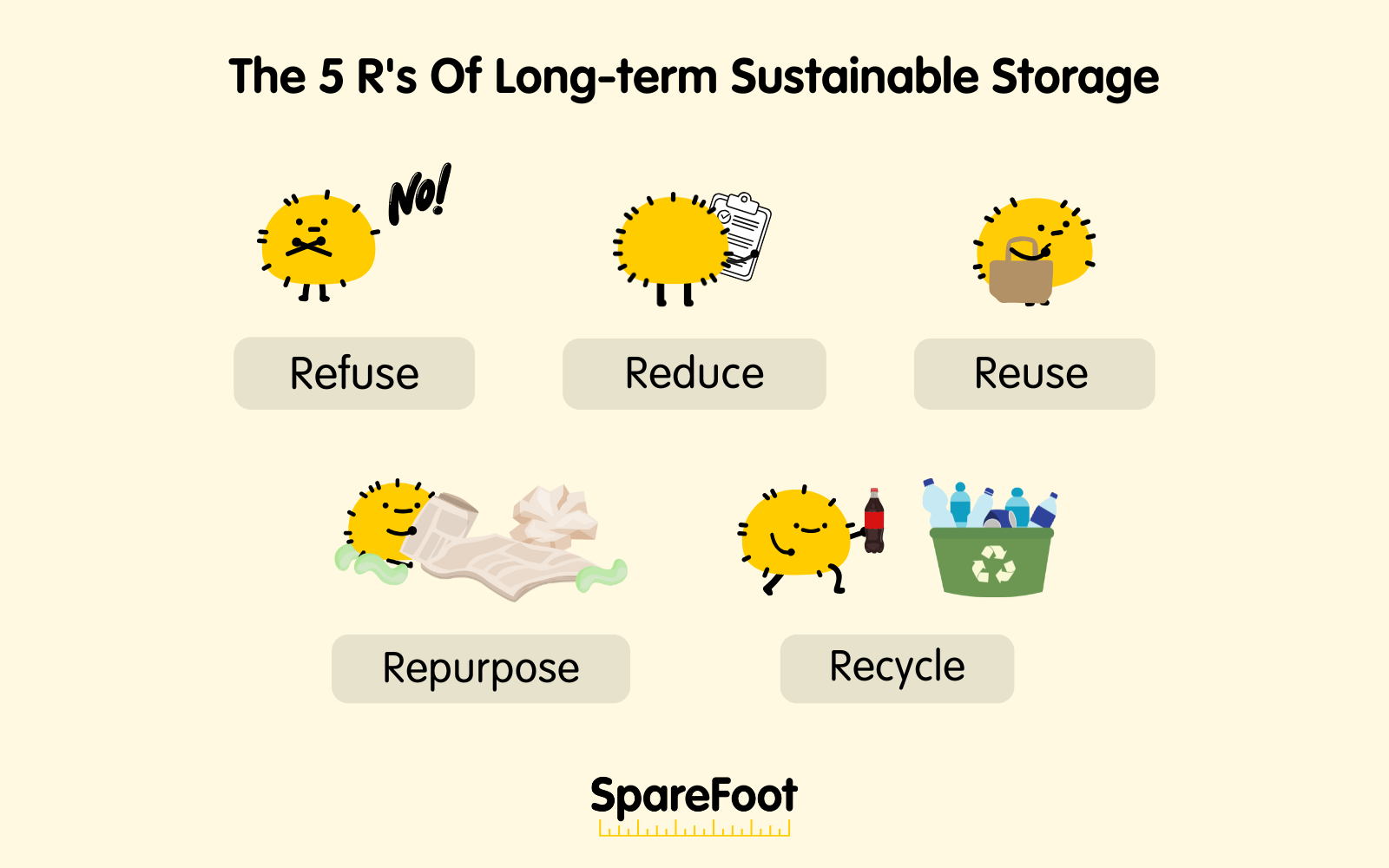
- Employ the 5 R’s of long-term eco-friendly storage:
- Refuse unnecessary items before they reach your storage.
- Reduce the quantity of items packed by keeping only what’s useful.
- Reuse containers, packing materials, and space efficiently.
- Repurpose items creatively instead of discarding them.
- Recycle what can no longer be reused.
So far, we’ve uprooted the conditioning behind our overconsumption, changed our habits to embrace conscious consumerism, and used eco-friendly self-storage to downsize our footprint.
We may understand the environmental and mental benefits of mindful spending, but what about the financial benefits?
Financial Impact of Mindful Spending
Once mindful spending becomes a lifestyle, you’ll notice significant financial gains. These gains include streamlined financial planning, a decrease in spending and an increase in savings, and enhanced capacity for managing debt.
Streamlined Financial Planning
Being conscious means being more aware, or being where we are in the here and now. Our mind and superego live under the assumption that if we’re not constantly thinking and planning for our future, our lives will fall apart. But what good is that future vacation we planned when it arrives if we spend the whole week preoccupied with planning ahead?
Conversely, mindful spending and the self-awareness we gain from tracking and changing our consumption drives bring us closer to being in the moment. After all, isn’t it in the present that we plan our future? By assessing our financial priorities in the present, we align our actions with our values.
When the investments and financial choices we make today are planted with focus and determination, like seeds, they naturally blossom in the future, setting our future self up with financial security.
Decrease in Spending = Increase In Savings.
When we’re present, clear-minded, and fulfilled, we realize that financial savings is quite literally all the money we didn’t spend, compounded over time.
By tracking and rewriting the mentalities that led to overconsumption in the first place, we’re building a capacity for fulfilment that doesn’t rely on consumption, and a natural resistance to the impulses and desires that keep us in the cycle of spending and consuming.
Mindful spending means not only limiting our consumption to the necessities, but also recognizing how little external stimulation we actually need to feel fulfilled when we’ve mastered our urges. It also comes with an increased awareness of our financial goals and a clear view of how to cut spending in order to achieve them.
Enhanced Capacity For Debt Management
By starting our process with cultivating an awareness of our consumeristic impulses and the associated emotional triggers, we can recognize and dissolve these urges before they start.
The resulting self-knowledge can help us curb what psychology refers to as the “Ostrich Effect.” The Ostrich effect is the tendency to avoid negative financial information that results from the tension between what our rational mind knows to be crucial and what our emotional mind fears will be painful.

The mental work we did to get to the point of mindful spending, and the increased financial awareness that follows, also enhances our capacity to view unpleasant realities. This increase in faculties allows us to view something like debt objectively, without collapsing under or repressing negative emotions.
Then, we can make a realistic and achievable plan to pay our debt off rather than avoiding it altogether.
Now that we understand the potential benefits our new mentality can bring, let’s take a look at where you can go from here and how SpareFoot can help you take the next step.
How SpareFoot Can Help You Achieve Mindful Living Through Conscious Consumption

So now you know how to become a minimalist in terms of spending and ethical consumption. But remember, mindful spending is a practice, and that means it takes practice. The goal isn’t to be a perfect consumer, but to be conscious of the quantity and quality of goods you consume.
The primary issue with consumerism is its non-sustainability. In order to mass-produce new versions of the same things over and over again, 24 hours a day, 7 days a week, we need to exploit resources.
Resource exploitation not only leads to climate change, pollution, and the destruction of biodiversity. It also requires a stagnant workforce, increases our debt, causes a gestalt of mental health issues, and increases the gap between the upper and lower classes.
Still, it’s unrealistic to think you can shrink your personal carbon footprint so small that it’ll reverse climate change. That said, there are manufacturers and resource cultivators whose social and environmental impacts are huge.
And since trends start with one person, your consumer habits and customer feedback could inspire the brands and corporations that can make a large-scale difference to do better.
Something as simple as switching your go-to coffee brand to a fairtrade coffee producer and sharing about it could start a movement that results in major coffee companies paying fair wages to their source.
You’re Not Alone – SpareFoot Is Here To Help
When it comes to decluttering your life, downsizing your belongings, and becoming a minimalist, most of the initial objections revolve around getting rid of sentimental belongings, even if you don’t use them. And creating a void overnight could result in more overconsumption as an attempt to fill it.
Start by getting rid of non-sentimental items to make room for both the things you use and the items that bring you comfort and peace, and help you stop consuming more stuff. But what about those of us who don’t have extra storage space?
That’s where we come in. Our SpareFoot Search Tool lets you search for storage units in your area based on the amenities you need, unit size, and storage deals.
One of the more popular deals storage facilities offer is one free month of storage. SpareFoot can limit your search results to facilities in your area that offer a free first-month move-in special!
Simply enter your zip code on our site to find an affordable storage unit that keeps your sentimental belongings safe, organized, and out of the way as you recycle, donate, minimize clutter, and track and reduce your consumption habits.
There are pros and cons to everything. A free market allows us to openly exchange goods, services, and ideas. But a free market doesn’t have to be consumeristic in nature. It can be oriented toward services, ideas, and practical, beneficial products that aren’t disposable.
However, actualizing that requires examining our own psychology to understand and untangle our constant desire for new, shiny stuff, whether or not we truly need it.
References and Further Reading
- Clutter and Mental Health: How Can Clutter Cause Stress, Affect Your Brain, and What to Do about Clutter Anxiety Clutter and Mental Health | How to Support a Healthier Mind
- Home and the extended-self: Exploring associations between clutter and wellbeing – ScienceDirect
- Dopamine Shopping: Understanding Retail Therapy
- The Commanding Self by Idries Shah – The Idries Shah Foundation
- The Ostrich Effect | Psychology Today
- The Theory of Holes | Ridhwan
- How can I practice conscious consumption? – VCU News – Virginia Commonwealth University
FAQs
Conscious consumption is making intentional purchases informed by an awareness of the cultural, social, psychological, and environmental impacts our purchase has. It involves researching brands, supporting ethical practices, and using critical thinking so our purchases align with our personal values and goals.
Examples of conscious consumption include using the 24-hour cool-off rule before purchasing, researching whether brands use fair trade practices, buying from local farmers’ markets instead of corporate chains, and choosing B Corp-certified products over greenwashed alternatives.
Conspicuous consumption is buying luxury goods just to display wealth and status. Purchasing designer handbags, expensive cars, or high-end electronics not for their utility or quality, or because you support the brand’s values, but to make other people jealous or to convey economic power, are examples of conspicuous consumption.
Conscious food consumption may involve monitoring our consumption until we know the difference between our desires and our needs. It can also refer to choosing organic, buying from local farmers’ markets, researching ingredient sourcing methods, supporting restaurants with sustainable practices, and avoiding brands that exploit workers or harm the environment.

Michael Ta’Nous
Michael Ta’Nous is a full-time writer who works and lives with his wife in Taos, New Mexico. “Mikey” spent his early twenties living either out of a van as a touring musician or out of a backpack on motorcycle trips writing from cafes–these rigorous adventure years polished him into a master packer. In addition to managing storage units full of catering supplies and outdoor gear professionally, Michael has used storage units as a band rehearsal space and a motorcycle garage.